CV
Curriculum vitae of Ronnakrit Rattanasriampaipong.
Updated November 2026 · same version as the PDF
Download PDF$326,000 funding awarded 159 citations · h-index 4 700+ students taught
Education
Professional Appointments
Grants & Fellowships
Total research and fellowship funding awarded: $326,000.
External
Internal
Publications
Papers published in refereed journals
All authors, my contribution, abstract and links
My contribution. Contributing author. Drafted the review's synthesis of the biological sources of marine tetraether lipids, distributed across several sections of the final paper. Designed the first draft of the figure (Figure 13) and finalized it with Felix Elling; it is featured on the journal cover, 41(7), July 2026. The paper was also an Eos Editors' Highlight (3 August 2026), which used the figure.
Abstract. Archaea are single-celled microorganisms that are abundant in marine environments and play a key role in the carbon and nitrogen cycles. Archaea can biosynthesize a wide variety of isoprenoid membrane lipids, including isoprenoid glycerol dibiphytanyl glycerol tetraethers (isoGDGTs). Experimental and empirical evidence demonstrates that the number of cyclopentane moieties in isoGDGTs is related to growth temperature, leading to the formulation and development of the TEX86 ocean temperature proxy. The TEX86 proxy has been widely applied to marine sediments spanning the last 190 million years and has revealed unique insights into the evolution of ocean temperatures over diverse timescales. Other indices have been developed using archaeal lipids to reconstruct ecological and biogeochemical processes that operate within the marine realm. However, several knowledge gaps (e.g., depth of export production, non-temperature controls, application in non-analogue climates) limit the application of archaeal lipid-based proxies in modern and ancient marine environments. In this review, we critically assess the utility of archaeal lipids as tracers for (paleo) environmental change, with an emphasis on the TEX86 paleotemperature proxy.
Links
All authors, my contribution, abstract and links
My contribution. Contributing author. Led the writing of the `data reporting and archiving' section and produced Figures 1 and 4.
Abstract. Abstract. Marine glycerol dialkyl glycerol tetraethers (GDGTs) are used in various proxies (such as TEX86) to reconstruct past ocean temperatures. Over 20 years of improvements in GDGT sample processing, analytical techniques, data interpretation and our understanding of proxy functioning have led to the collective development of a set of best practices in all these areas. Further, the importance of Open Science in research has increased the emphasis on the systematic documentation of data generation, reporting and archiving processes for optimal reusability of data. In this paper, we provide protocols and best practices for obtaining, interpreting and presenting GDGT data (with a focus on marine GDGTs), from sampling to data archiving. The purpose of this paper is to optimize inter-laboratory comparability of GDGT data, and to ensure published data follows modern open access principles.
Abstract, figures and links
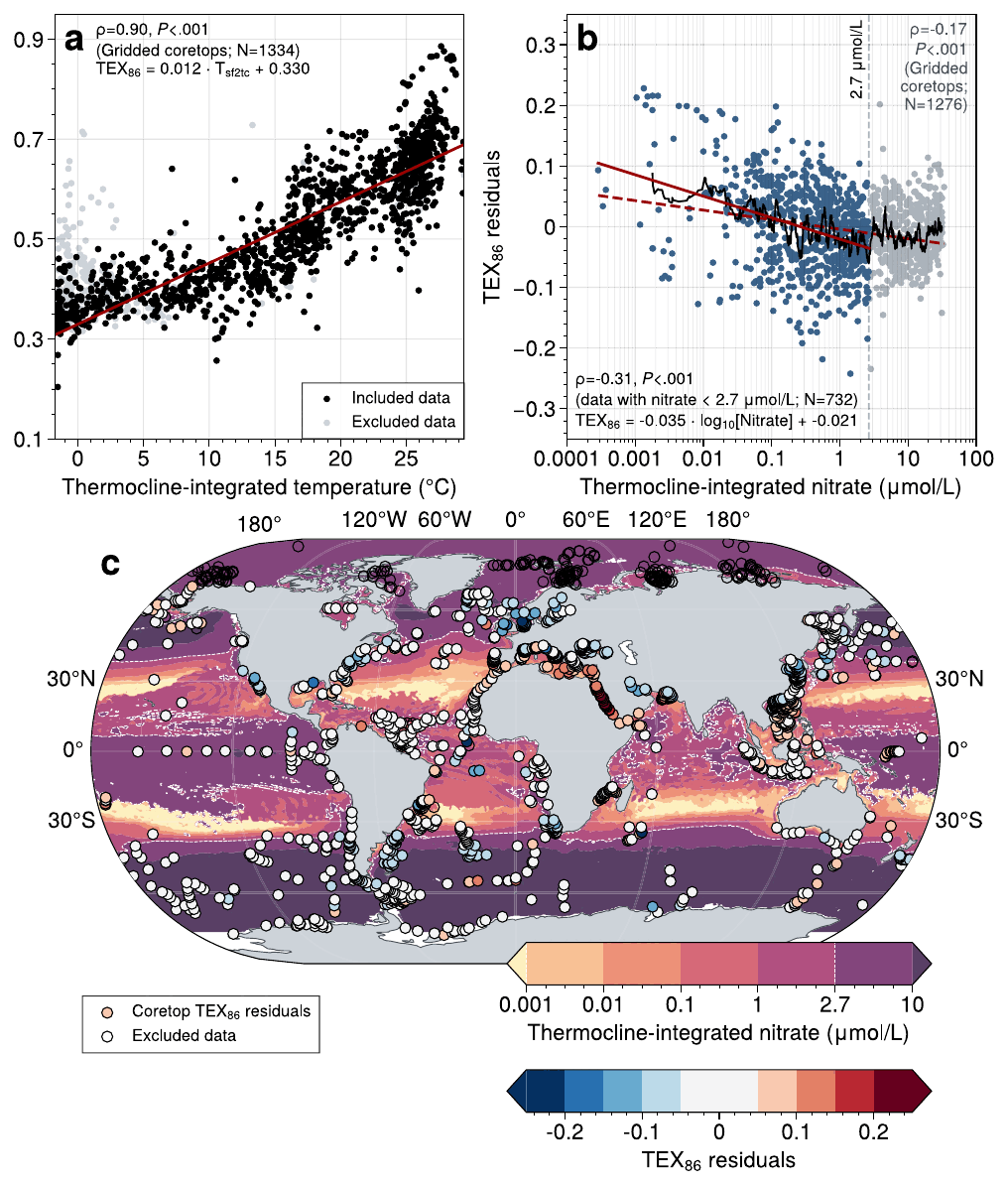
Abstract. The TEX86 paleotemperature proxy is widely used to reconstruct ocean surface temperatures over the past 100 million years. However, archaeal culture experiments show that nutrient stress elevates TEX86 values by increasing glycerol dialkyl glycerol tetraether (GDGT) cyclization. Here, we demonstrate that this “nutrient effect” is also recorded in sedimentary GDGTs. Using an expanded core-top database, we find a significant negative correlation between TEX86 and nitrate concentrations (ρ = -0.31; P<.001) once the thermal effect is removed. There are stronger correlations (ρ -0.73 to -0.91; P<.001) in regions with steep nitrate gradients. Comparisons between TEX86 and UK'37-based reconstructions from the Arabian Sea and Tasman Sea suggest that nutrient stress influenced GDGT distributions during glacial-interglacial cycles. Our findings underscore the need to account for nutrient effects when applying TEX86 paleothermometry.
All authors, my contribution, abstract and links
My contribution. Contributing author. Entered and quality-controlled a substantial share of the compiled records.
Abstract. Paleotemperature proxy data form the cornerstone of paleoclimate research and are integral to understanding the evolution of the Earth system across the Phanerozoic Eon. Here, we present PhanSST, a database containing over 150,000 data points from five proxy systems that can be used to estimate past sea surface temperature. The geochemical data have a near-global spatial distribution and temporally span most of the Phanerozoic. Each proxy value is associated with consistent and queryable metadata fields, including information about the location, age, and taxonomy of the organism from which the data derive. To promote transparency and reproducibility, we include all available published data, regardless of interpreted preservation state or vital effects. However, we also provide expert-assigned diagenetic assessments, ecological and environmental flags, and other proxy-specific fields, which facilitate informed and responsible reuse of the database. The data are quality control checked and the foraminiferal taxonomy has been updated. PhanSST will serve as a valuable resource to the paleoclimate community and has myriad applications, including evolutionary, geochemical, diagenetic, and proxy calibration studies.
Abstract, figures and links
Abstract. Archaeal membrane lipids are widely used for paleotemperature reconstructions, yet these molecular fossils also bear rich information about ecology and evolution of marine ammonia-oxidizing archaea (AOA). Here we identified ‘thermal’ and ‘non-thermal’ behaviors of archaeal glycerol dialkyl glycerol tetraethers (GDGTs) by comparing the GDGT-based temperature index (TEX86) to the ratio of GDGTs with two and three cyclopentane rings (GDGT-2/GDGT-3). Thermal-dependent biosynthesis should increase TEX86 and decrease GDGT-2/GDGT-3 when the ambient temperature increases. This presumed temperature-dependent (PTD) trend is observed in GDGTs derived from cultures of thermophilic and mesophilic AOA. The distribution of GDGTs in suspended particulate matter (SPM) and sediments collected from above the pycnocline— ‘shallow-water’ samples—also follows the PTD trend. These similar GDGT distributions between AOA cultures and shallow-water environmental samples reflect ‘shallow’ ecotypes of marine AOA. While there are currently no cultures of ‘deep’ AOA clades, GDGTs derived from ‘deep-water’ SPM and marine sediment samples exhibit non-thermal behavior deviating from the PTD trend. The presence of ‘deep’ AOA increases the GDGT-2/GDGT-3 ratio and distorts the temperature-controlled correlation between GDGT-2/GDGT-3 and TEX86. We used Gaussian Mixture Models to statistically characterize these diagnostic patterns of modern AOA ecology from paleo-GDGT records to infer the evolution of marine AOA from the Mid-Mesozoic to the present. Long-term GDGT-2/GDGT-3 trends suggest the suppression of today’s ‘deep-water’ marine AOA during the Mesozoic–early Cenozoic greenhouse climates. Our analysis provides insights into the evolutionary timeline and the expansion of AOA niches associated with major oceanographic and climate changes.


Links
Manuscript(s) submitted, under review, under revision, preprint and/or in-press
All authors and links
All authors and links
Technical Reports
Description
Full pre-drill assessments for four drilling projects, including geological risk, economic justification, and wireline logging and formation testing programs.
Software & Open-Source Contributions
Description and links
Hierarchical Bayesian proxy system model for TEX86 paleothermometry, implemented in Stan. Released as the open-source Python package texas-psm (MIT), with archived, versioned releases on Zenodo. Linked to Rattanasriampaipong et al. (2026).
Papergithub.com/PaleoLipidRR/TEXASpypi.org/project/texas-psmdoi.org/10.5281/zenodo.19671664
Technical Skills & Languages
Research Experience
Highlights
- Designed and developed a comprehensive proxy system modeling framework for the TEX86 paleotemperature proxy to reconstruct ancient climate conditions
- Discovered and quantified the influence of nutrient levels on TEX86 proxy accuracy, identifying “nutrient stress” effects in surface marine sediments through analysis of global and regional lipid distribution patterns
- Developing an innovative lipid-based paleotemperature proxy using Bayesian inference methodology implemented in Stan programming language
Highlights
- Compiled and synthesized a large archaeal membrane lipid database (N>3000) spanning 192 million years, and identified the spatio-temporal gaps that thin the record before ca. 100 Ma
- Characterized archaeal lipid distribution patterns linked to archaeal ecology in marine environments
- Investigated potential of novel subclasses of archaeal membrane lipids as a proxy for ocean (de)oxygenation
Field & Shipboard Experience
Highlights
- Conducted oceanographic sampling operations on a day cruise in Galveston Bay: Niskin-bottle and handheld CTD seawater sampling, seafloor grab sampling, Secchi-disk turbidity, and seawater pumping for biological and trace-metal analyses.
Highlights
- Achieved 90% accuracy in pre-drill vs. post-drill hydrocarbon reserves estimation across 20 gas wells.
- Performed real-time stratigraphic correlation using wireline triple-combo logs and reassessed pore-pressure profiles during drilling.
Highlights
- Monitored real-time drilling operations in the Gulf of Thailand for two weeks on a barge tender rig, covering formation pressure acquisition, formation integrity tests (FIT), and rig-floor operations.
Highlights
- Conducted multi-season field excavation and stratigraphic analysis of tsunami deposits on Phra Thong Island, Thailand: trench logging, grain-size and sedimentological description, and sample collection for geochemical analysis.
Teaching Experience
Taught and mentored over 700 undergraduate students, the large majority of them non-majors, across four sections as instructor of record for an introductory ocean-and-climate course and two courses as a teaching assistant. My teaching emphasizes active learning through hands-on data analysis, real-world applications of Earth science, and practices that support students from a wide range of backgrounds and preparation levels.
Department of Oceanography, Texas A&M University
Terms and ratings, description and links
| Role | Term | Students (rating) |
|---|---|---|
| Instructor of record | Spring 2021 | 194 (4.78/5.00) |
| Instructor of record | Summer 2021 | 48 (4.86/5.00) |
| Instructor of record | Summer 2022 | 116 (4.64/5.00) |
| Instructor of record | Fall 2022 | 36 (4.41/5.00) |
| Teaching assistant | Spring 2023 | 300 |
OCNG 251, The Blue Planet — Our Oceans, is Texas A&M's introductory oceanography course for non-majors and satisfies a general-education science requirement. As instructor of record I held sole responsibility for syllabus design, recorded lectures, assessment, and grading across four asynchronous online sections enrolling up to 194 students. Its central theme is the ocean's role in the climate system.
Terms and ratings, description and links
| Role | Term | Students (rating) |
|---|---|---|
| Teaching assistant | Spring 2023 | 30 (5.00/5.00) |
GEOS 470, Data Analysis Methods in Geosciences, is an upper-level, project-based course in which students analyze real geoscience datasets in MATLAB; I led programming sessions and one-on-one code review for a class of 30.
** Student evaluations of my own teaching, on the item “The instructor fostered an effective learning environment” (Scale: 1 = Strongly Disagree, 5 = Strongly Agree). Ratings are shown only for roles in which students evaluated me directly.
Professional Experience
Highlights
- Conducted detailed geological assessments in extensional basins (fluvio-deltaic environments) using integrated datasets including 3D seismic, wireline logs, and production records.
- Managed and analyzed geological data from over 5,000 wells to generate pore pressure analyses, geostatistical reserve estimates, and regional pressure-temperature models.
- Collaborated across disciplines (geology, drilling, reservoir engineering) to optimize exploration and development strategies in the Gulf of Thailand.
- Developed a novel method for evaluating reservoir pressure using gas shows and wireline log data.
- Contributed to reserves estimation, stratigraphic correlation, and target redefinition for future platforms within the Dara geologic trend.
Invited Talks & Lectures
Conducted in English
Conducted in Thai
Presentations
Academic & Scientific Conferences
Industry
Research Mentoring & Advising
Description and highlights
Trained and supervised 4 on-campus and visiting undergraduate students in laboratory preparation and analysis of archaeal lipid biomarkers (GDGTs) by LC-MS, from sample intake through data quality control:
- Freeze-drying and homogenizing marine mud samples from ocean drilling programs.
- Extracting total lipid extracts (TLE) using an Accelerated Solvent Extractor (ASE).
- Purifying samples for LC-MS analysis via cellulose filtering and silica-gel column chromatography.
Description
Mentored 2 newly hired geologists on a Gulf of Thailand drilling project in wireline log interpretation, stratigraphic correlation, pore pressure prediction, and well design.
Invitations, Awards & Honors
Invitations
Awards
Scholarships
Honors
Travel Grants
Synergistic Activities (Leadership, Service, & Outreach)
Description
Journals reviewed for:
Biogeosciences (n = 1), Chemical Geology (2), Climate of the Past (1), Frontiers in Marine Science (2), Folia Microbiologica (1), Geochimica et Cosmochimica Acta (3), Geophysical Research Letters (6), Global and Planetary Change (2), Nature Geoscience (1), Organic Geochemistry (4), Paleoceanography and Paleoclimatology (10), Science Advances (2).
Description
Co-initiated (with Jarunetr Sae-lim), coordinated, and presided over the session Past Climates and Environments of Southeast Asia and the Indo-Pacific (PaleoSEA) within the Paleoclimatology and Paleoceanography (PP) section.
Description
Founded a virtual community connecting Thai graduate students and early-career researchers in the Earth and climate sciences across U.S. institutions, begun during the pandemic to share mentoring, application advice, and research talks.
Description
Served as a volunteer Thai interpreter for Thai high school participants presenting their year-long science research projects at the world’s largest pre-collegiate science competition.
Description
Served as a judge for the Climate Talk session at GeoDaze, Department of Geosciences, and evaluated undergraduate posters for the School of Earth and Environmental Sciences (SEES) poster session.
Description
Led the keynote session Disciplinary Integrations with Organic Geochemistry at the 2024 Gordon Research Seminar.
Description
Co-authored a letter advocating for continued NSF funding of U.S. Scientific Ocean Drilling (SciOD), which was signed by 208 Early Career Researchers from 98 institutions across 17 countries.
Description
Co-authored GPSG.R.53.05, a resolution advocating for Texas A&M University to reduce fossil fuel investments, which was subsequently passed by the Graduate and Professional Student Government (GPSG) Senate.
Press and Media Coverage
Interviewed Articles in English
Interviewed Articles in Thai
Panel Discussions in Thai
Workshops
Professional Development
Texas A&M University's G.R.A.D. Aggies Professional Development Program
Foreign Fulbright Student Program
Chevron In-House Training (Energy Company Technology)
Professional Societies
Personal Interests
Science communication, Infographics, Data visualization, Marathon and ultra-distance running
The PDF version is at paleolipidrr.github.io/assets/pdf/CV_Rattanasriampaipong.pdf